The Top-12 Method: How to Find YouTube Video Ideas That Already Have an Audience
There is one mistake almost every new creator makes, and it happens before a single frame is shot.
You pick a niche by feel. You like animals, so you make animal videos. Artificial intelligence is loud right now, so you make AI videos. Somebody else’s channel crossed a million views, so you go and do the same thing.
YouTube does not reward the person who enjoys the work most. It rewards the person who reads the market most accurately. And one of the cheapest ways to read a market is sitting in plain sight on every competitor’s channel page: the twelve videos that pulled the most views.
Not to copy. To count.
The majority principle, stated plainly
Inside a set of videos that have already proven they attract an audience, the sub-topic that appears most often is the one with the highest probability of working for you too.
That is the whole idea. You are not guessing what viewers want. You are looking at what they already clicked, watched and pushed further into the recommendation system.
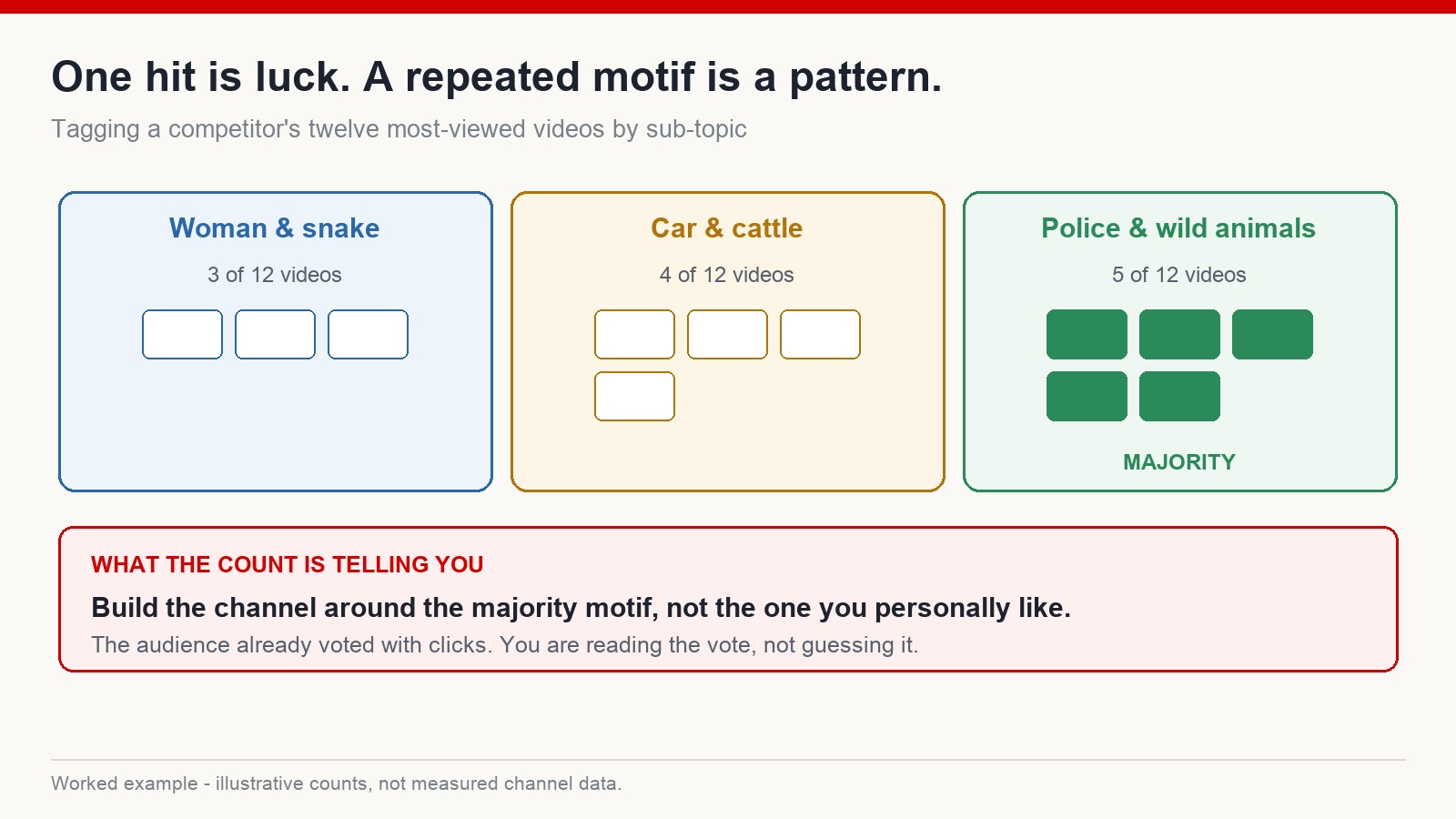
Say you open a competitor in the animal space and sort by most popular. Across the twelve biggest videos you count three about a woman and a snake, four about cars and cattle, and five about police officers and wild animals. The majority group is obvious. It is not the group you find most interesting. It is the group the audience voted for.
Why twelve and not three
One viral video can be luck. Two can be coincidence. But when several of a channel’s biggest hits share a motif, that is no longer noise. That is a pattern, and on YouTube the people who read patterns move considerably faster than the people who do not.
Twelve is small enough to analyse in an afternoon and wide enough to show a trend. Look at only the top three and you can be badly misled: a single freak hit will convince you the whole channel is built on a topic it barely touches. Across twelve you start to see what actually repeats.
- Which sub-topic comes back most often
- Which characters keep appearing
- Which settings pull well
- Which thumbnail logic earns the click
- Which keywords the titles keep reusing
- Which formats the audience clearly accepts
That is data. Not inspiration, not general advice, not somebody’s opinion.
Step one: qualify the competitor before you analyse it
This step matters more than it looks. Pick the wrong channel and every conclusion after it inherits the error.
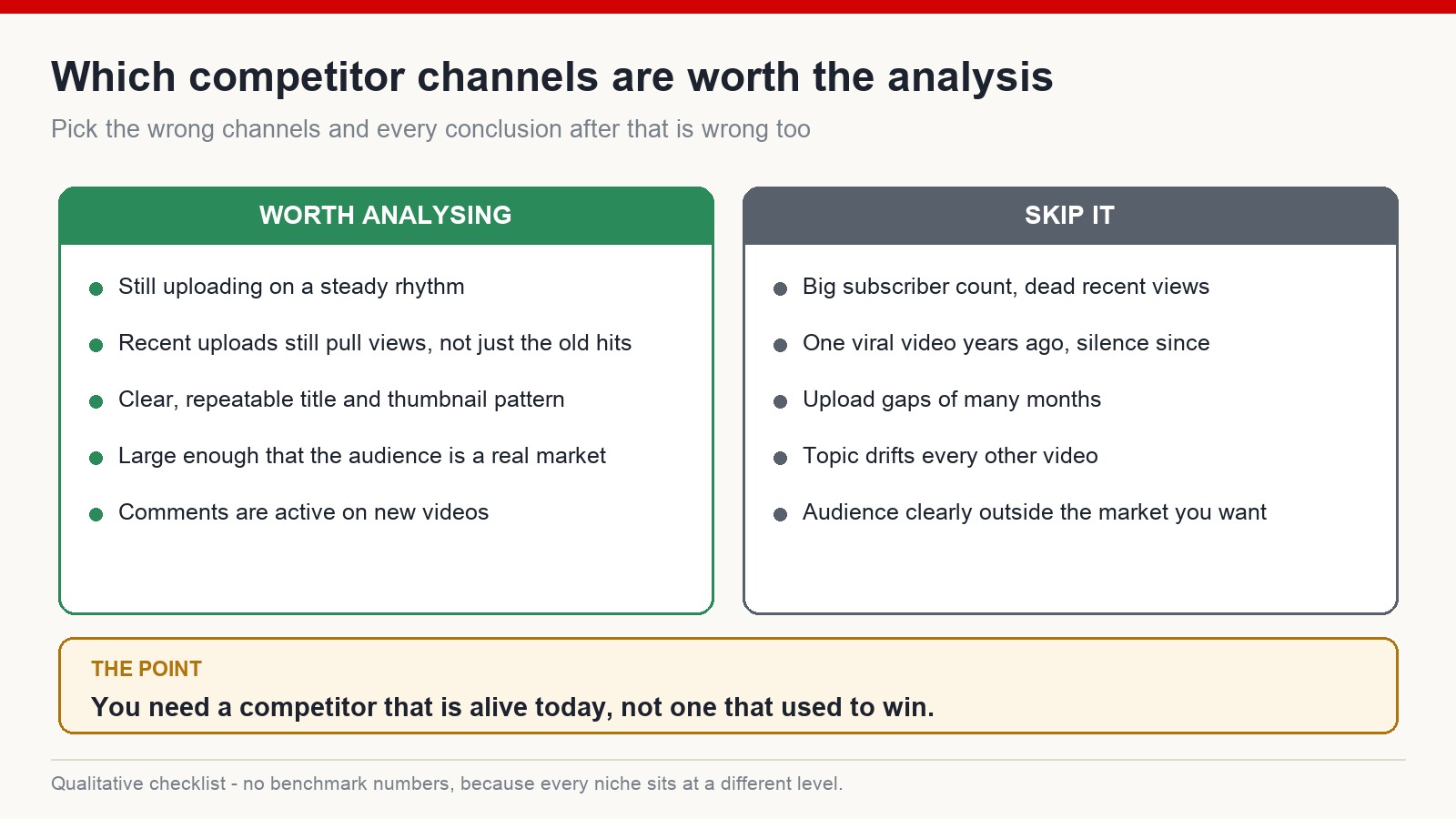
A channel worth your time is a channel that is still alive. It uploads on a rhythm. Its recent videos still pull views, not just the hits from three years ago. Its comment sections are active. And it is big enough that its audience represents a real market rather than a hobby.
Resist the urge to judge by subscriber count alone. Plenty of large channels are coasting on a number they earned years ago: new uploads land quietly, the schedule wobbles, the old topics are no longer being pushed. If you remake a channel like that, you are remaking a market that has already cooled.
Step two: pull the twelve and write them down
Open the channel, go to the Videos tab, sort by Popular, and take the twelve at the top. Then build the plainest possible spreadsheet:
- Title
- Views
- Publish date
- Main sub-topic
- Central character or subject
- Setting
- Standout keywords
- Thumbnail type
- Hook type
- Notes on anything that repeats
It does not need to be sophisticated. It does need to be written down. Patterns that are invisible when you scroll become obvious the moment they sit in adjacent rows.
Step three: break each hit into its components
A video does not win on topic alone. It wins because several elements combine.
Take a title like Police Rescue Wild Animals From a Dangerous Situation. Pull it apart:
- Character: police officers
- Subject: wild animals
- Situation: a rescue
- Emotion: danger, tension, and something decent at the end of it
- Setting: roads, forest, the edge of a town
- Format: caught-on-camera rescue
- Audience: people who like animals, people who like action, people who like a story with stakes
Once you can do that, you stop seeing a title and start seeing a recipe. That is the point at which remaking gets intelligent instead of lazy.
Step four: group the twelve into content lines
Now cluster. In the example above you end up with three lines: woman and snake (three videos), cars and cattle (four), police and wild animals (five). The counting has done the arguing for you. The third line is the spine.
Step five: take the majority as your spine, not as a script
Here is where people go wrong. Finding five videos about police and wild animals does not mean making five near-identical copies of them. What you take is the axis: officers, wild animals, a dangerous situation, a rescue.
From one axis you can build many variations:
- Police Rescue Wild Animals From Busy Roads
- Wild Animals Saved by Police Officers
- Dangerous Animal Encounters With Police
- Officers Save Animals From Extreme Situations
- Brave Officers Help Injured Wild Animals
That is remaking a structure. It is not cloning a video, and the difference is enormous.
The 4:1 publishing rotation
Once you have your spine, a second mistake shows up quickly: publishing nothing but the spine. Same motif every day, near-identical thumbnails, titles that change by two words. That reads as spam to a viewer and it looks repetitive to a system that is now quite good at measuring similarity.
A safer rhythm is four to one. Four videos on the majority motif, then one video on a second motif that also appeared in that top twelve. Four more, then another change of pace.
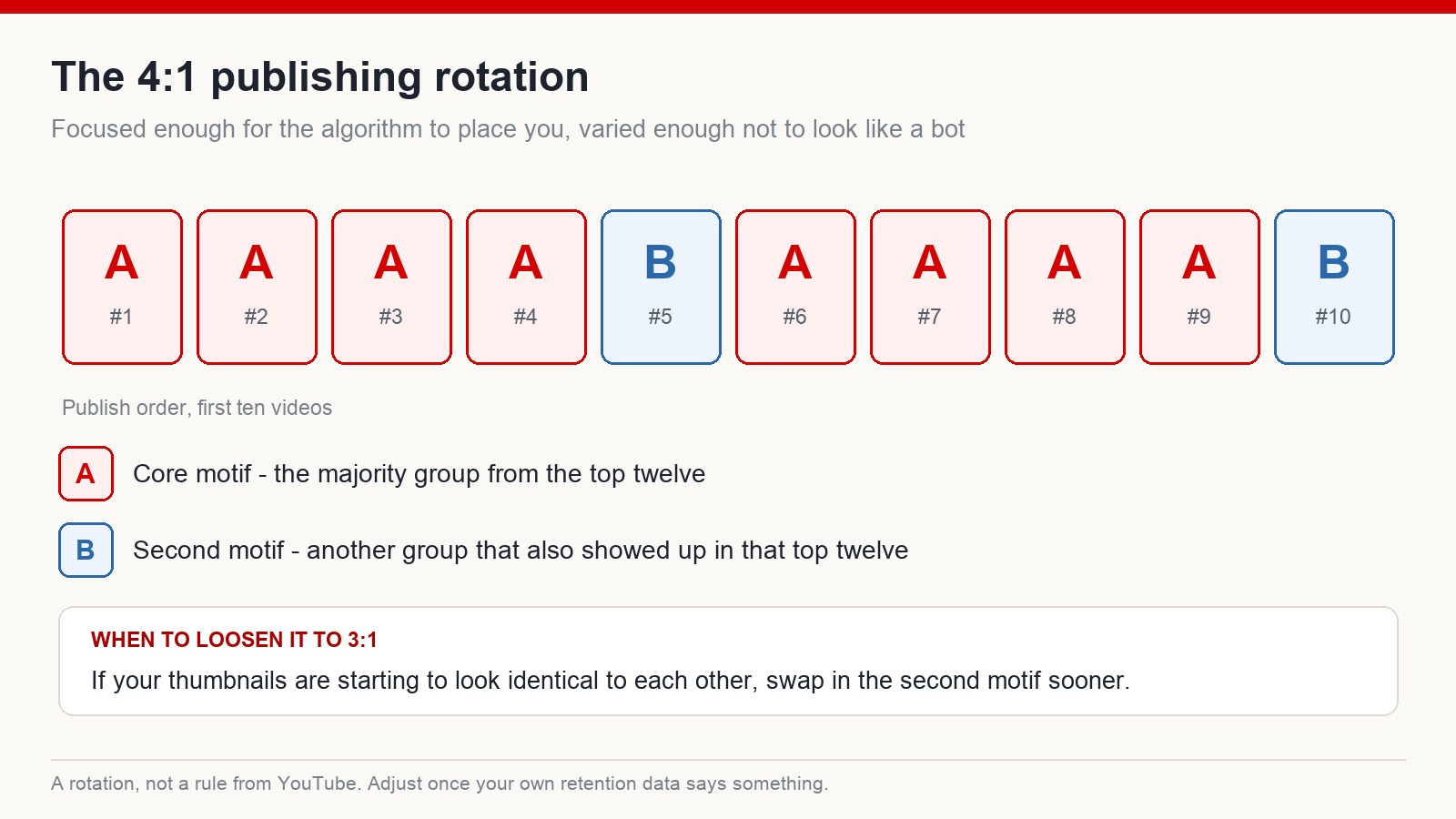
The channel keeps a clear centre without becoming monotonous.
When to loosen it to 3:1
If your niche makes thumbnails that look alike no matter what you do, bring the second motif in sooner: three and one. That widens the audience faster.
Do not widen too early, though. The single most important job of a new channel is to make it obvious who it serves. Jump across too many topics and the recommendation system never settles on an audience to test you with. In the first stretch I would rather be a bit too focused than a bit too broad.
The entry-door test: check a small channel too
Reading only large channels is how people talk themselves into markets they cannot enter. A big channel has advantages you do not have: history, a subscriber base, production capacity, and the benefit of the doubt from the algorithm. Its success proves demand. It proves nothing about whether there is room for you.
So run a second check. Search the keywords your analysis surfaced and look for a channel that is small and young but clearly outperforming its size on the same motif. Few subscribers, few videos, recent uploads doing far better than the channel’s scale would suggest.
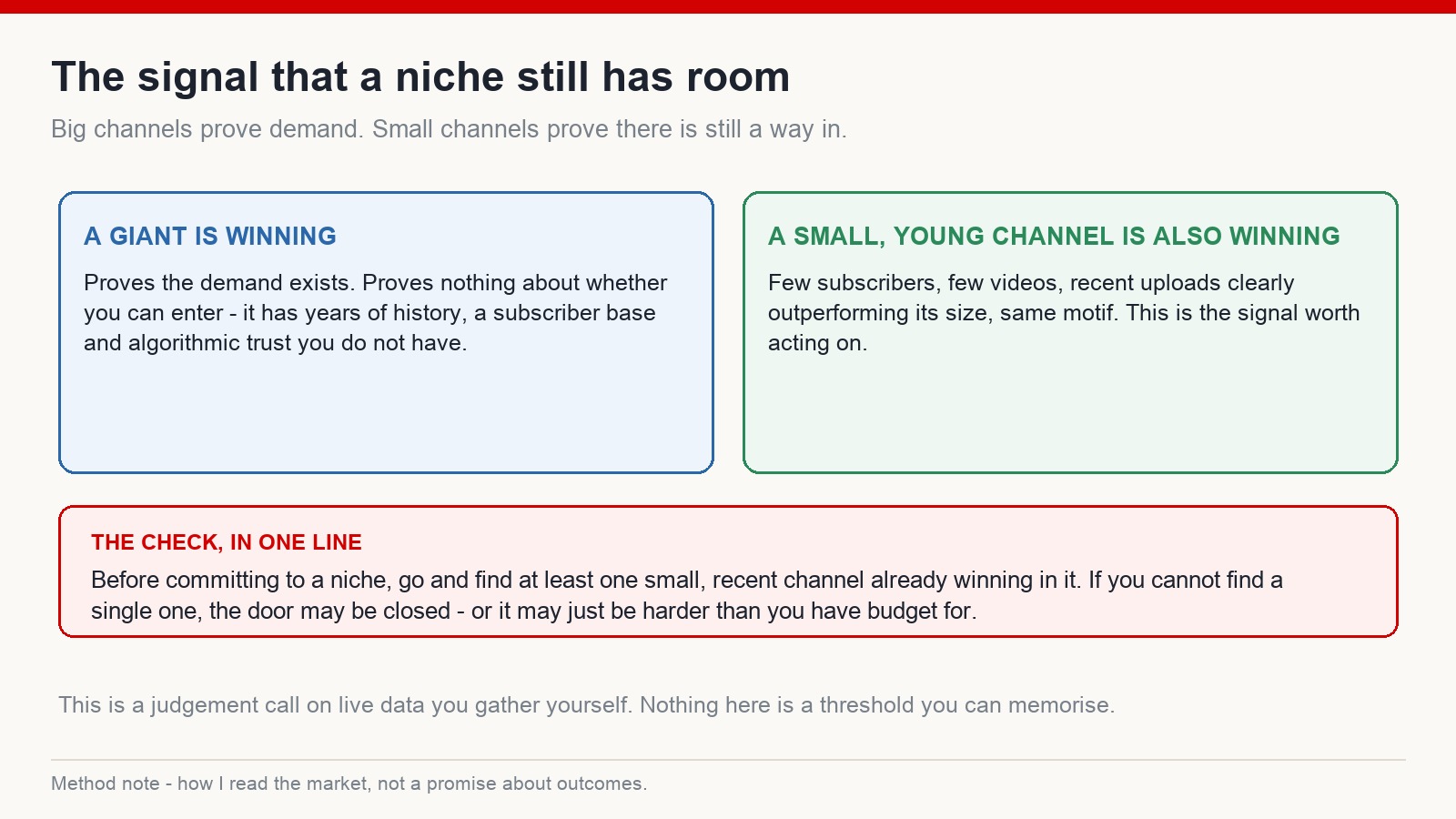
Find one and you have something genuinely valuable: evidence that the door is open, not just that the room is full. Find none, and proceed carefully. It may still be workable, but it will cost you more time and more patience than the numbers first suggested.
Remaking is not copying
This needs saying bluntly. Remaking does not mean taking someone else’s video and repackaging it.
Do not lift the thumbnail. Do not reuse the title word for word. Do not rewrite their script lightly and call it yours. Do not take their footage and trim it. Beyond the copyright exposure, this is exactly the behaviour that gets a channel classed as repetitive or low-value content, and channels in that category rarely last.
What you can legitimately carry across is the structural layer: the topic axis, the viewer need, the emotional register, the storytelling format, the hook shape, the thumbnail logic. Everything on top of that has to be yours.
How to upgrade a remake
Suppose the competitor has 10 Wild Animals Rescued by Police Officers. The wrong move is to publish something within a word or two of it. The right move is a different angle on the same demand:
15 Times Police Officers Risked Their Lives to Save Wild Animals shifts the emphasis onto the risk the officers take, which gives you a deeper script and a more emotional thumbnail.
Police Officers Had No Idea This Rescue Would Be Watched Around the World turns a list into a story, which changes the whole pacing of the video.
Same demand, different product.
Use AI to analyse, not to launder
Language models are genuinely useful in this workflow, and genuinely dangerous if you point them at the wrong task.
The good use is analysis. Feed in the titles, descriptions and transcripts you collected and ask harder questions than you would ask yourself: which emotion is this video actually selling? How does the opening earn the next thirty seconds? Who is the target viewer? Which angle is missing from this whole set of twelve? What moment should the thumbnail freeze?
Then ask for a new script with its own narration, its own pacing, its own structure, its own hook and its own examples. The model is a strategist. It is not a photocopier, and a channel built on lightly reworded copies of other people’s videos is a channel with a short life expectancy.
Script upgrades that actually change retention
The most common failure in a remake is thin writing: the title moves slightly, the script moves slightly, the visuals are close, the pacing is identical, and the idea is ninety per cent the same. A viewer has no reason to choose you, and the platform has no reason to keep pushing you.
Add a point of view
Do not just report what happened. Instead of “the elephant charged the vehicle”, try something with stakes in it: “for a few seconds the driver had nowhere to reverse to — and the frightening part was not the animal’s strength, it was that every wrong decision from here made the situation worse”. Same footage, different experience.
Add reasons to stay
Every section should hand the viewer a reason to sit through the next one. A line like “what happened next is the part nobody expected” is doing real work. Retention is built out of small promises kept, not out of word count.
Add direction, not just narration
A script that will be edited well tells the editor what to do: open on the most intense moment, push in on the point of danger, cut fast through the first few seconds, hold no shot longer than its content justifies, drop a short caption where the meaning could slip. That is the difference between a remake and a product.
One small habit before upload
Rename the file before you upload it. Not final_video_01.mp4 but police-rescue-wild-animals.mp4.
This is not magic and anyone who sells it as a growth hack is overselling it. It is simply one more signal pointing the same direction as the title, the description, the tags, the thumbnail, the captions and the content itself. When everything agrees, the platform has an easier time working out what your video is.
The process, end to end
- Choose the market you want to serve.
- Find five to ten live channels inside it — uploading regularly, recent videos still performing, clear title and thumbnail patterns.
- Pull the twelve most-viewed videos from each and log them in a sheet.
- Break each one into components and group them into content lines.
- Take the majority line as your spine.
- Check for a small, recent channel winning on the same motif before you commit.
- Plan the schedule on a four-to-one rotation.
- Remake with a real upgrade: script, hook, thumbnail, angle, research, pacing.
Mistakes that undo all of this
Thumbnails that sit too close to the original. Thumbnails are the easiest thing in the world to catch. Copy the layout, colours, subject and text placement and your channel simply looks derivative. Learn the logic; do not trace the picture.
Titles that are near-identical. Keep the core keyword by all means. Change the packaging: from a list to a story, from “caught on camera” to “went badly wrong”, from something general to something specific.
Running one motif into the ground. Even a winning motif needs variation, or viewers tire of it and the channel starts to look like an assembly line.
Skipping the small-channel check. Looking only at giants is the fastest way to convince yourself a closed market is open.
Adding nothing. A remake without an upgrade is just a weaker copy, and weaker copies do not last on this platform.
Structure does not kill creativity
Some creators resist this whole approach because it feels like a loss of imagination. I would argue the opposite. Working from proven demand does not remove creativity; it gives creativity something to push against.
Instead of guessing what an audience might want, you start from what an audience has already demonstrated it wants, and then you add the things nobody can copy from you: your angle, your voice, your pacing, your standard of research, the experience of watching your version rather than theirs.
Creativity does not have to start from nothing. Sometimes it is looking at a formula that works and making it clearer, sharper and more worth someone’s time.
Stop building on instinct
The top-twelve method is not there so you can copy. It is there so you can read: which sub-topics have an audience, which motifs are currently winning, which themes repeat often enough to be worth committing to, and whether a newcomer still has a way in.
Compressed to a line: pick live channels, pull the top twelve, group them, take the majority, verify with a small channel, remake with an upgrade, publish four to one.
You do not need to reinvent the game as a beginner. You need to know what the market is asking for, and then build a version of it that is clearer and better than what is already there. Results still depend on how consistently you execute and how the platform’s policies evolve — nothing here removes that.
If you want a step-by-step programme to practise this on a real channel rather than reading about it, that is what I run over at mmoyoutube.com.
Frequently asked questions
Is remaking a YouTube video the same as copying?
No. Remaking means studying the structure behind a video that worked and building a new version with your own script, angle and packaging. Copying means reproducing the title, thumbnail, script or footage more or less as they are.
Why twelve videos rather than three?
Twelve is enough to separate a pattern from a fluke. A single hit can be luck; several hits sharing a motif tells you the demand is real.
What is the majority principle?
Pick the sub-topic that appears most often across a competitor’s proven hits. The group with the largest share has already had its demand demonstrated by viewers.
What does a 4:1 rotation mean?
Four videos on your core motif, then one on a second motif that also appeared in the competitor’s top twelve. It keeps the channel focused without letting it become repetitive.
Why does a small competing channel matter so much?
Because a giant channel proves demand exists but says nothing about whether a newcomer can enter. A small, recent channel winning on the same motif is the evidence that the door is still open.
Is renaming the video file before upload worth doing?
It is a small, free habit that makes your signals consistent. It will not make a weak video succeed, and anyone presenting it as a shortcut is exaggerating.